How to Write Product Descriptions AI Actually Recommends
Most product descriptions are invisible to AI assistants. Learn the specific structure, language, and content that makes AI recommend your products.
TL;DR: AI-friendly product descriptions answer specific questions, avoid vague marketing language, and structure information for easy extraction. Here's exactly how to write them.
Why Most Product Descriptions Fail with AI
Traditional product descriptions are written to persuade humans. They use emotional language, creative metaphors, and brand voice.
AI doesn't care about any of that.
When ChatGPT evaluates whether to recommend your product, it asks:
- Does this answer the user's specific question?
- Can I extract concrete details?
- Do I have enough information to recommend confidently?
Most product descriptions fail these tests.
The AI-Readable Description Formula
Structure your product descriptions in this order:
1. Lead with What It Is (Not Why It's Great)
Traditional (AI-unfriendly): "Experience the revolution in home cooking. Our premium blender brings professional-grade performance to your countertop."
AI-friendly: "The BlendPro 1400 is a 1400-watt countertop blender designed for daily smoothie making, soup blending, and food processing in home kitchens."
AI needs to know what the product IS before anything else.
2. State Who It's For
Traditional: "Perfect for anyone who loves fresh, healthy food."
AI-friendly: "Best for home cooks who make smoothies 3-5 times per week, families wanting a versatile kitchen tool, and anyone upgrading from a basic blender."
Be specific about the ideal user.
3. List What It Does (With Numbers)
Traditional: "Powerful blending crushes through anything with ease."
AI-friendly: "Blends frozen fruit and ice in 45 seconds. Processes nut butter in 3 minutes. Crushes ice in under 30 seconds. Makes hot soup in 8 minutes through friction heating."
Concrete capabilities with measurable details.
4. Include Honest Limitations
Traditional: [Nothing—limitations are never mentioned]
AI-friendly: "Not designed for commercial use, extended blending beyond 6 minutes, or fully hot liquids above 180°F."
Limitations build trust and help AI filter appropriately.
5. End with Key Specs
Traditional: "Sleek design fits any kitchen aesthetic."
AI-friendly: "Specifications: 1400W motor, 64 oz pitcher, 64 dB noise level, 8"×9"×17" dimensions, 12.5 lbs weight, 10-year motor warranty."
Specs in a scannable format.
Before & After: Full Description Rewrite
Before (Traditional Product Description)
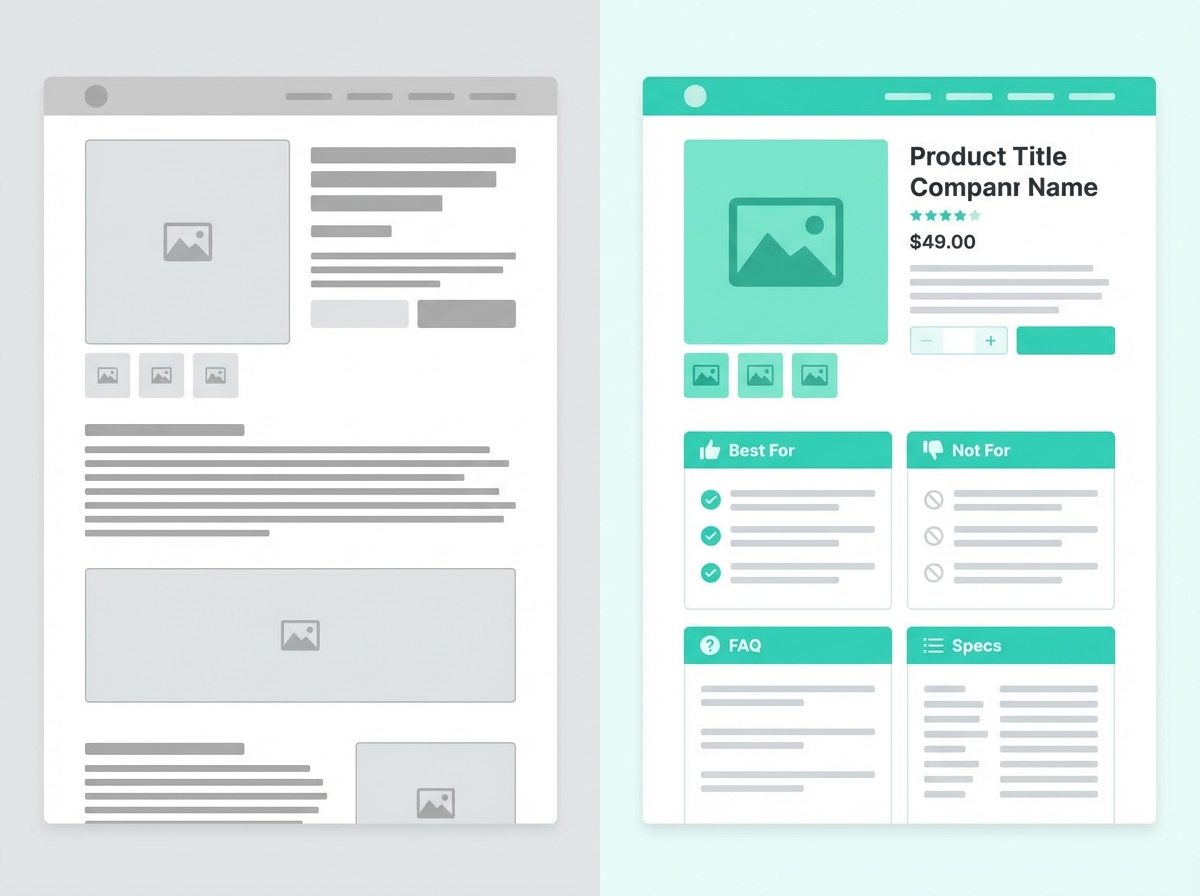
The Ultimate Blending Experience
Transform your kitchen with the BlendPro 1400. This isn't just a blender—it's a revolution in how you think about food preparation.
Our engineering team spent three years perfecting the blade design to deliver unparalleled performance. The powerful motor tears through even the toughest ingredients while maintaining whisper-quiet operation.
From morning smoothies to gourmet soups, the BlendPro 1400 handles it all with style. The sleek design complements any kitchen decor, while the intuitive controls make operation a breeze.
Join thousands of satisfied customers who've upgraded their kitchen game. Experience the BlendPro difference today.
Problems:
- No concrete specifications
- Vague claims ("powerful," "whisper-quiet," "tough ingredients")
- No mention of who it's for or not for
- Nothing AI can extract for constraint matching
After (AI-Friendly Description)
BlendPro 1400 — 1400W Countertop Blender
The BlendPro 1400 is a 1400-watt countertop blender designed for daily smoothie making, soup blending, and food processing in home kitchens.
Best For:
- Home cooks who make smoothies 3-5 times per week
- Families wanting one versatile blending solution
- Health-focused buyers who prep soups, nut butters, and baby food
- Anyone upgrading from a basic blender
What It Does:
- Blends frozen fruit and ice in 45 seconds
- Makes nut butter from raw almonds in 3-4 minutes
- Crushes 2 cups of ice in under 30 seconds
- Heats soup through friction blending (8 minutes)
- Purees baby food to smooth consistency
Not Ideal For:
- Commercial or restaurant use (designed for home frequency)
- Processing boiling liquids (max 180°F)
- Extended blending sessions over 6 minutes
- Those needing ultra-quiet operation (64 dB during use)
Specifications:
- Motor: 1400 watts
- Capacity: 64 oz (8 cups)
- Noise level: 64 decibels
- Dimensions: 8" W × 9" D × 17" H
- Weight: 12.5 lbs
- Settings: 10 variable speeds + 4 presets
- Warranty: 10-year motor, 2-year parts
Compared to Alternatives: Similar power to Vitamix E310 at $100 less. Quieter than Ninja Professional (64 dB vs 72 dB). More durable than budget options—built to last 10+ years.
Why this works:
- Clear product identification
- Specific user profiles
- Measurable capabilities
- Honest limitations
- Complete specifications
- Competitive context
Language Patterns AI Understands
Replace Vague with Specific
| Vague (avoid) | Specific (use) | |---------------|----------------| | Powerful motor | 1400-watt motor | | Whisper quiet | 64 decibels | | Long battery life | 8 hours of playback | | Lightweight design | 3.4 pounds | | Fast performance | Blends ice in 30 seconds | | Large capacity | 64 oz / 8 cups | | Durable construction | 10-year warranty | | Quick charging | 0-80% in 30 minutes |
Use Constraint-Matching Language
Write descriptions that match how users ask questions:
User asks: "What's a good blender for someone who makes smoothies every morning?"
Your description should include: "Best for home cooks who make smoothies 3-5 times per week" (or "daily smoothie makers")
User asks: "Is this quiet enough to use early morning?"
Your description should include: "64 decibels—similar to normal conversation. Quieter than most blenders in this power range, but not silent."
Include "Works With" and "Doesn't Work With"
Works with:
- Standard US outlets (110V)
- All BlendPro accessories and containers
- Countertops with 17"+ clearance
- Dishwasher (pitcher and lid only)
Doesn't work with:
- 220V power systems (international)
- Third-party containers
- Under-cabinet installation
- Dishwasher (motor base)
Structuring Descriptions by Product Type
Physical Products
[What it is + key spec]
[Best for: 3-5 specific user types]
[What it does: capabilities with numbers]
[Not ideal for: limitations]
[Specifications: full specs table]
[Compatibility: what it works with]
[Comparison: vs 2-3 alternatives]
Digital Products / Software
[What it is + primary function]
[Best for: user types and use cases]
[Key features: with specific capabilities]
[Requirements: technical specs]
[Not ideal for: wrong-fit scenarios]
[Comparison: vs alternatives]
[Pricing: clear tier breakdown]
Services
[What you get + deliverables]
[Best for: ideal client profiles]
[What's included: specific components]
[What's not included: scope limits]
[Timeline: how long things take]
[Comparison: vs DIY or alternatives]
Common Mistakes to Avoid
Mistake 1: Burying Key Information
Bad: Key specs are hidden in tabs or collapsed sections. Good: Most important information is in the main description body.
Mistake 2: Using Subjective Claims
Bad: "The best blender you'll ever own" Good: "Rated 4.8/5 stars from 1,200+ verified purchases"
Mistake 3: Writing Walls of Text
Bad: Long paragraphs with no structure. Good: Headers, bullet points, and short sections.
Mistake 4: Forgetting Mobile
Bad: Description only makes sense with full context visible. Good: Each section stands alone and makes sense when viewed independently.
Mistake 5: Inconsistency Across Platforms
Bad: Different specs on your site vs Amazon vs Google Shopping. Good: Identical information everywhere.
Template: AI-Friendly Product Description
Copy and customize this template:
**[Product Name] — [Key Spec or Identifier]

[One sentence: What it is and primary purpose]

## Best For
- [User type 1 with specific context]
- [User type 2 with specific context]
- [User type 3 with specific context]

## What It Does
- [Capability 1 with measurable detail]
- [Capability 2 with measurable detail]
- [Capability 3 with measurable detail]
- [Capability 4 with measurable detail]

## Not Ideal For
- [Limitation 1 with brief explanation]
- [Limitation 2 with brief explanation]
- [Limitation 3 with brief explanation]

## Specifications
- [Spec 1]: [Value]
- [Spec 2]: [Value]
- [Spec 3]: [Value]
- [Spec 4]: [Value]
- [Spec 5]: [Value]

## Compared to Alternatives
- **vs [Competitor A]:** [Honest comparison]
- **vs [Competitor B]:** [Honest comparison]


**[Common question 1]?**
[Direct answer]

**[Common question 2]?**
[Direct answer]

**[Common question 3]?**
[Direct answer]
Quick Wins: Improve Any Description in 15 Minutes
-
Add a "Best For" section (5 minutes) List 3-5 specific user types
-
Add a "Not Ideal For" section (5 minutes) List 3-5 limitations or wrong-fit scenarios
-
Replace one vague claim with a specific number (5 minutes) Find your most marketing-speak sentence, make it concrete
Related reading: 10 questions every product page must answer · constraint coverage · 'Not Ideal For' section
FAQ
How long should an AI-friendly product description be?
Long enough to answer key questions—typically 300-600 words. Don't pad with fluff, but don't skimp on important details.
Should I remove all marketing language?
No. You can still have brand voice and persuasive elements. Just make sure concrete information comes first.
Will this hurt conversion rates?
Usually improves them. Customers who buy are better informed, leading to fewer returns and better reviews.
Should I rewrite all my products at once?
Start with top sellers. Learn what works, then apply to the rest.
How do I know if it's working?
Test with AI assistants monthly. Ask about your product category and see if you get mentioned.
For the full checklist including AI readiness, see our Product Page SEO Checklist for 2026.
Want to see how your product pages score for AI readiness? Scan your page free →
Ready to optimize your product pages?
Scan your listings for SEO and AI readiness issues in 30 seconds.
Run Free Scan