How AI Shopping Assistants Choose Products to Recommend
AI shopping assistants match buyer constraints, not keywords. Learn exactly how they evaluate and recommend products.

TL;DR: AI shopping assistants evaluate products by matching them to specific buyer constraints—not by keyword density or backlinks. If your product page doesn't explicitly answer "Is this right for me?", AI will recommend a competitor instead.
The Shift From Search to Recommendation
Shopping behavior has fundamentally changed.
The old way:
- Customer searches "best wireless earbuds"
- Google shows 10 links
- Customer clicks through, compares, decides
The new way:
- Customer asks "What are the best wireless earbuds for running that won't fall out under $100?"
- AI evaluates dozens of products
- AI recommends 3-5 that match the specific constraints
- Customer clicks one link or buys directly
The difference matters for your store. In traditional search, you optimize for keywords. In AI-assisted shopping, you optimize for constraint matching—proving your product fits the shopper's exact situation.
Over 60% of shoppers now use AI assistants for product research. If AI doesn't recommend you, you're invisible to a growing majority of buyers.
How AI Shopping Assistants Actually Work
Here's what happens when someone asks ChatGPT, Perplexity, or Google's AI for a product recommendation.
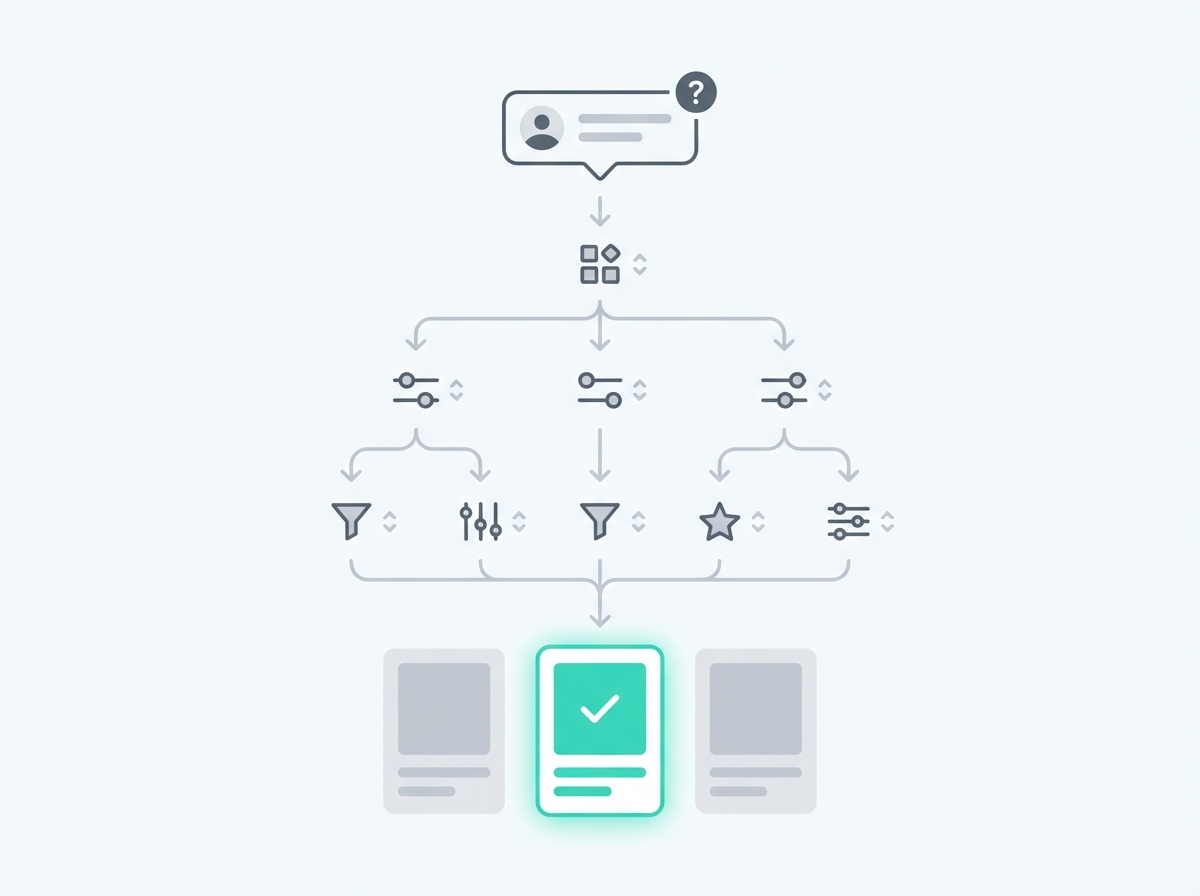
Step 1: Intent Parsing
The AI breaks down what the user actually wants. Not just the product category, but the specific constraints.
User query: "I need a coffee grinder for pour-over, budget around $50, and it needs to be quiet because I make coffee early while my family sleeps."
AI parses:
- Product: Coffee grinder
- Use case: Pour-over brewing
- Budget: Around $50
- Constraint: Quiet operation
- Context: Early morning use, family sleeping
The AI isn't looking for pages with "coffee grinder" mentioned repeatedly. It's looking for pages that explicitly address pour-over grinding, price point, and noise level.
Step 2: Source Gathering
AI pulls information from multiple sources:
- Product pages (yours and competitors)
- Review sites
- Reddit discussions
- Expert blogs
- Shopping databases
Here's the critical insight: if your product page doesn't contain the constraint information, AI gets it from Reddit instead—where a random user might say your product is "kinda loud."
Step 3: Constraint Evaluation
For each potential product, AI asks:
| Constraint | Does the page answer this? | |------------|---------------------------| | Good for pour-over? | Yes / No / Unclear | | Under $50? | Yes / No | | Quiet operation? | Yes / No / Not mentioned | | Why this over alternatives? | Yes / No |
Products that clearly answer all constraints get recommended. Products with gaps get skipped.
Step 4: Confidence Scoring
AI assistants have a confidence threshold for recommendations. They hesitate to recommend when:
- Information is incomplete ("I'm not sure if this works for pour-over")
- Signals are contradictory (page says "quiet" but reviews say "loud")
- No differentiation (can't explain why this vs alternatives)
- Missing exclusions (doesn't know who it's NOT for)
When confidence is low, AI either recommends a competitor with clearer information, adds heavy caveats, or asks the user for clarification instead.
Step 5: Response Generation
Finally, AI generates a recommendation including:
- Product name and brand
- Why it matches the user's needs
- Key specifications from structured data
- Caveats or limitations if known
- Alternatives for comparison
What Makes a Product Page "AI-Recommendable"
Based on how these systems work, here's what your product page needs.
Explicit "Best For" Statements
AI needs to know who your product serves best.
Bad: "Great for coffee lovers everywhere!"
Good: "Best for pour-over and French press brewing. The 40 grind settings let you dial in the perfect coarseness for manual brewing methods."
Clear "Not Ideal For" Exclusions
This is the most overlooked factor. AI assistants are more confident recommending products that clearly state limitations.
Bad: No mention of limitations
Good: "Not ideal for espresso brewing (burrs can't achieve fine enough grind) or commercial use (designed for home kitchens)."
Why does this help? When a user asks for an espresso grinder, AI can confidently exclude your product and move on—rather than awkwardly recommending it with caveats.
Constraint-Answering Content
Your page should anticipate and answer common constraints:
| Constraint Type | Example Questions | Your Page Should Answer | |-----------------|-------------------|------------------------| | Fit/Size | "Will this fit in my cabinet?" | Dimensions + comparison to common items | | Compatibility | "Does this work with my Chemex?" | Compatible products listed | | Skill Level | "Good for beginners?" | Explicit skill level recommendation | | Use Case | "Can I use this for cold brew?" | Supported and unsupported use cases | | Maintenance | "Is this hard to clean?" | Cleaning process + time estimate | | Noise | "How loud is it?" | Decibel level or comparison |
FAQ Section
AI assistants love FAQ sections because they're pre-parsed question-answer pairs.
Q: Is this grinder quiet enough for early morning use?
A: At 65 decibels, it's comparable to normal conversation—quieter
than most burr grinders but not silent.

Q: Can I grind directly into a portafilter?
A: The hopper height works with most home espresso machines,
but check your portafilter height (we recommend under 3.5 inches).
Comparison Context
AI needs to explain why your product versus alternatives. Help it:
Bad: No mention of competitors
Good: "Unlike blade grinders, our burr design ensures consistent particle size. Compared to the Baratza Encore, we offer 10 additional grind settings at a lower price point—though the Encore has a slightly more powerful motor."
Complete Structured Data
AI parses Schema.org markup for price, availability, ratings, and specifications. Incomplete schema means less data for AI to work with.
Platform-Specific Behaviors
ChatGPT Shopping
ChatGPT with browsing/shopping enabled tends to:
- Favor products with comprehensive descriptions
- Pull heavily from structured data
- Cite specific features when explaining recommendations
- Acknowledge uncertainty when information is missing
Optimization focus: Rich, specific product descriptions with clear constraint coverage.
Perplexity Shopping
Perplexity's shopping features tend to:
- Aggregate from multiple review sources
- Show price comparisons
- Surface user reviews and Reddit discussions
- Favor products with strong consensus ratings
Optimization focus: Consistent messaging across all platforms (your page, reviews, social).
Google AI Overview
Google's AI shopping summaries tend to:
- Heavily weight structured data
- Pull from Google Shopping feed
- Incorporate review snippets
- Favor Google-verified merchants
Optimization focus: Complete schema markup and Google Merchant Center optimization.
How to Test If AI Recommends Your Products
Manual Testing Method
- Identify your key constraints—what do customers ask before buying?
- Craft test prompts matching real customer queries
- Test across ChatGPT, Perplexity, Google AI, and Claude
- Document results: Were you mentioned? Recommended? What was said?
Test Prompt Templates
"What's the best [your product category] for [common use case]?"

"I need a [product] under [$price] that [key requirement]. What do you recommend?"

"[Your product] vs [competitor]—which is better for [use case]?"

"Is [your product] good for [specific constraint]?"
What to Track
| Metric | What It Tells You | |--------|-------------------| | Mention rate | Are you in the conversation? | | Recommendation rate | Are you actively recommended? | | Positioning | How are you described? | | Constraint accuracy | Does AI have your constraints right? |
Common Reasons AI Skips Products
Missing "Not For" Information
AI can't confidently recommend because it doesn't know who to exclude.
Vague Descriptions
Generic marketing copy doesn't answer specific constraints.
Before: "Experience superior grinding performance!" After: "Grinds 2oz of beans in under 30 seconds with consistent particle size (±50 microns variance)."
No Use Case Specificity
Page doesn't clearly state what situations the product is best for.
Missing Comparisons
AI can't explain why your product versus alternatives.
Incomplete Schema
AI can't extract structured product data reliably.
Contradictory Information
Your page says one thing, reviews say another.
Action Items: Get Recommended This Week
Quick Wins (Do Today)
- Add a "Best For" section with 3-5 specific use cases
- Add a "Not Ideal For" section with honest limitations
- Create an FAQ with 5-10 common pre-purchase questions
- Check your schema—is Product and Offer markup complete?
This Month
- Audit constraint coverage—what questions does your page answer?
- Add compatibility information
- Include comparison context
- Test with AI assistants
Ongoing
- Monitor AI recommendations across platforms
- Update based on customer questions
- Keep information fresh and accurate
Related reading: get your products recommended by ChatGPT · why AI assistants skip your products · AEO for ecommerce
FAQ
How do AI shopping assistants find products?
AI assistants pull from multiple sources including product pages, review sites, Reddit, and shopping databases. They evaluate each product against the user's specific constraints.
Do AI assistants use keywords like Google?
No. AI assistants focus on constraint matching and semantic understanding, not keyword density. They look for pages that answer specific buyer questions.
Can I pay to get recommended by AI?
No. AI recommendations are based on content quality and constraint coverage, not advertising spend. The only way to get recommended is having better information than competitors.
How often should I test AI recommendations?
Test monthly at minimum. AI systems update frequently, and your competitors are also optimizing.
Does product schema help with AI recommendations?
Yes. Structured data helps AI extract accurate information about price, availability, ratings, and specifications.
Want to see how your product pages score for AI readiness? Scan your page free →
Ready to optimize your product pages?
Scan your listings for SEO and AI readiness issues in 30 seconds.
Run Free Scan